How Many Pomodoros a Day: The Arithmetic Behind Every Number You Have Read
You searched for how many pomodoros a day, and every answer you found was a different whole number: eight, twelve, sixteen. None of them showed the multiplication, and at least one of the top-ranking ones gets it wrong by up to a full hour.
The honest answer has two halves. One is arithmetic you can check in a minute, and it is on this page. The other is a number only your own days can tell you, and no article has it.
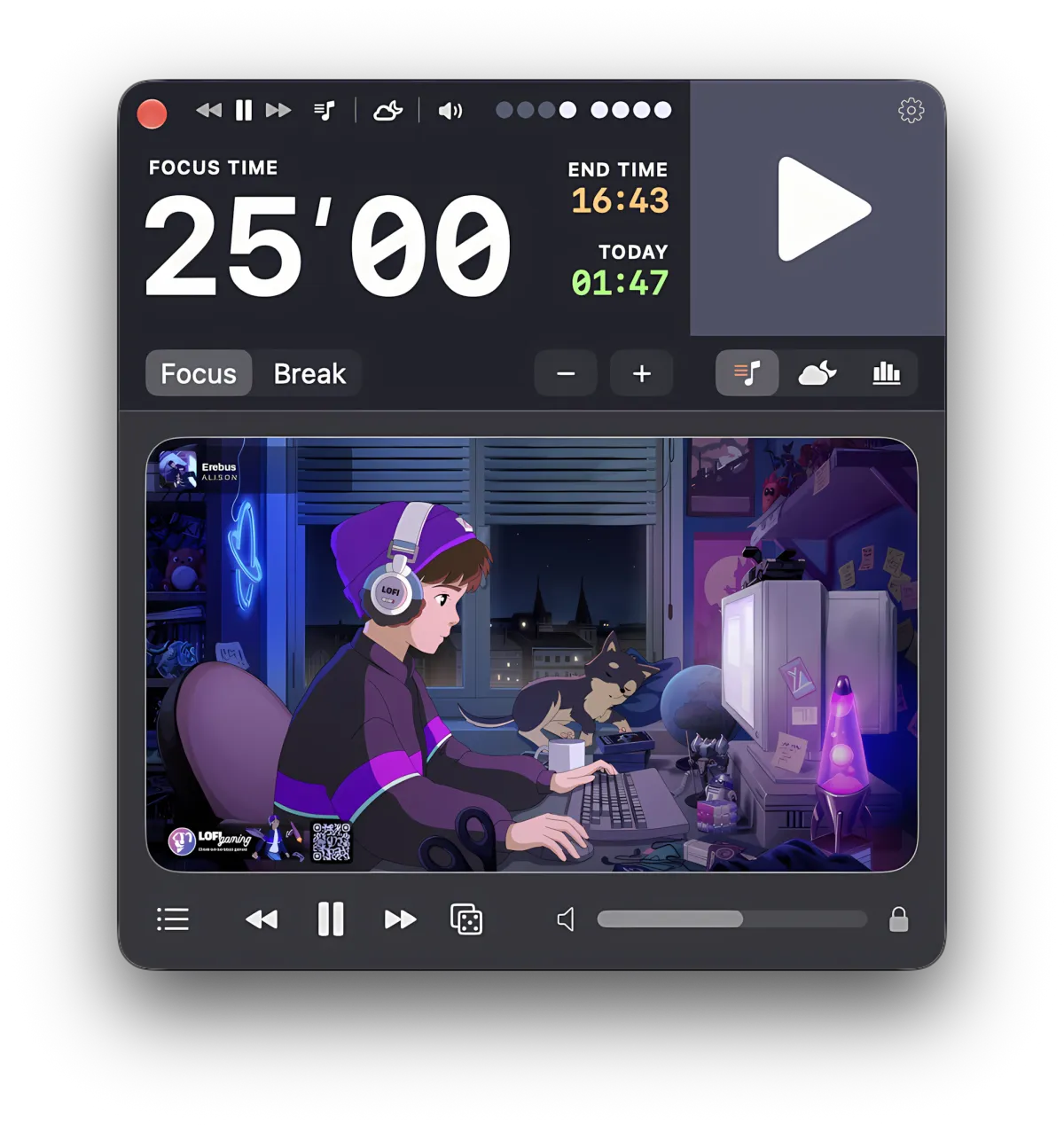
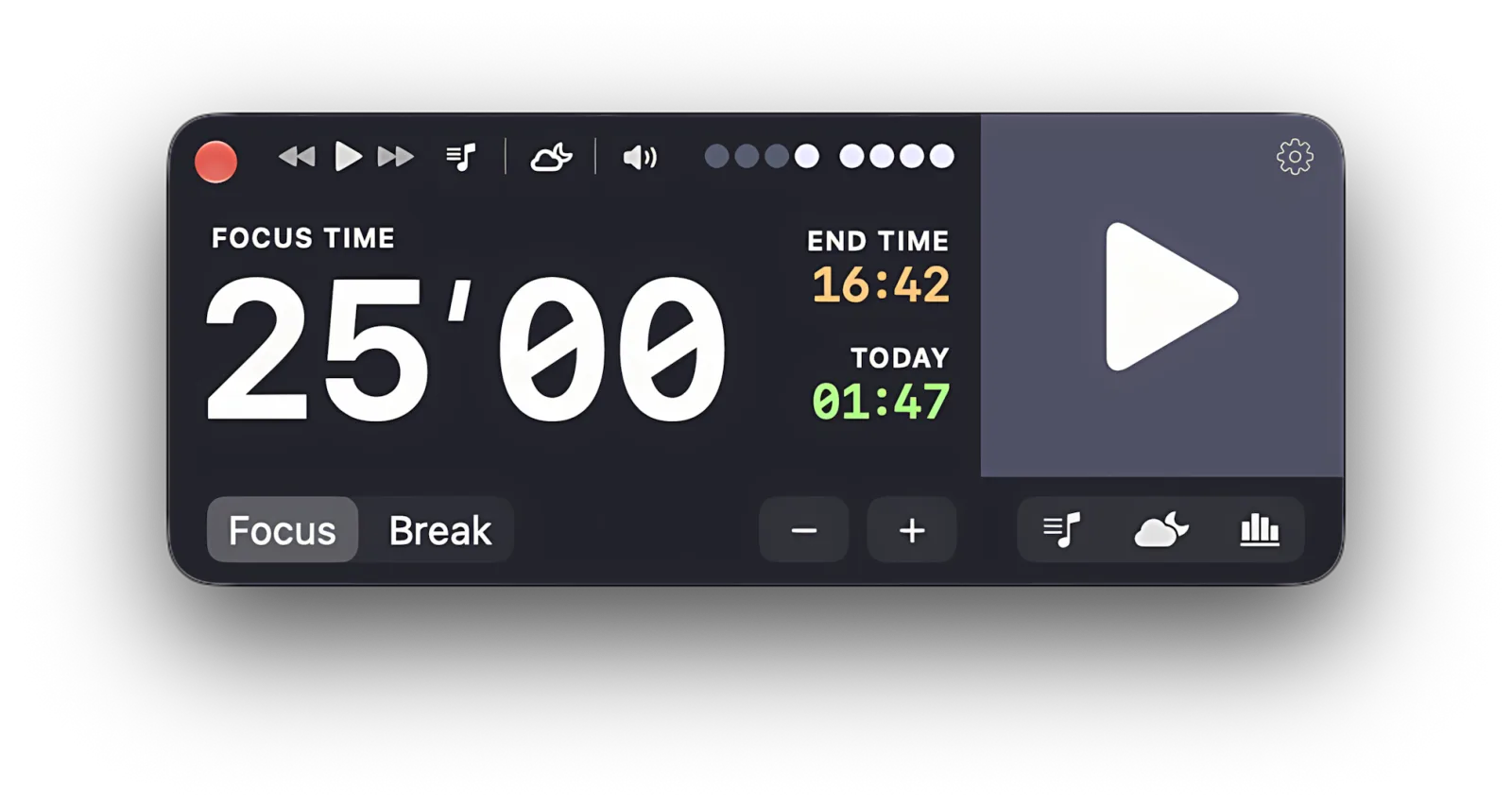
Focusito is a Mac timer that writes down every session with its planned and actual length, so after a week the second half of the answer is a table instead of a guess. The page below is the arithmetic, the ceilings for an 8-hour day, and why the count is the wrong thing to track.
A pomodoro is 25 minutes, so eight of them is 3 hours 20 minutes of focus, not four hours, and twelve is five hours, not six. Most pages that give you a daily number quietly count the break as work.
Nothing more than 15 fit in an eight-hour day at the textbook lengths, and that assumes no lunch, no meetings, and no email. Real days hold far fewer, and the sustainable number is yours to find, not anyone's to prescribe.
If you track one thing, track minutes of focus against what you planned. The count of finished blocks hides both the sessions you cut short and the ones you ran long.

Still counting tomatoes on a sticky note at the end of the day? Focusito records every session as it ends, planned length next to actual length, and totals the last 7, 30, or 90 days in minutes. The "how many" question answers itself from the log, with the shortened sessions and the overruns visible instead of rounded away.
It does not tell you how many you should do, there is no task list and no estimating a task in pomodoros, and a session you stop inside its first minute is not counted as focus. After the trial the statistics page is part of the one-time purchase.
A pomodoro is 25 minutes, and the ranking pages round it to 30
A pomodoro is one block of focus. At the textbook length that is 25 minutes, followed by a 5-minute break. The break is real time, but it is not focus, and the moment you blend the two the daily numbers start lying.
One of the pages ranking for this exact question, on dartai.com, put it like this in October 2026, verbatim: “between 8 and 12 Pomodoros per day, which translates to approximately 4 to 6 hours of deeply focused work”. Multiply it out:
| Blocks | Focus only (× 25 min) | Focus plus short breaks (× 30 min) |
|---|---|---|
| 8 | 200 min = 3 h 20 min | 240 min = 4 h |
| 12 | 300 min = 5 h | 360 min = 6 h |
The “4 to 6 hours” is the right-hand column. It only appears if every 5-minute break is counted as deeply focused work. The actual focus in that range is 3 hours 20 minutes to 5 hours: 40 minutes less at the bottom and a full hour less at the top.
Check it yourself: take any daily figure you have been given, multiply by 25, and divide by 60. If the article’s hours come out higher than yours, it counted the breaks. There is nothing more to it, and no app needed; the Calculator on your Mac does it, or a single line in Spotlight.
How many fit in an 8-hour day: three ceilings
Fit as many blocks as possible into 480 minutes, with no meetings, no lunch, no email, and nothing that overruns. This is the ceiling, not a target, and it moves a lot with the break lengths.
| Schedule | Blocks that fit in 8 h | Focus inside those 8 h | What the day looks like |
|---|---|---|---|
| 25 focus / 5 break, 15-minute break after every fourth | 15 | 6 h 15 min | three full rounds of four, then three more with 5 minutes to spare |
| 25 / 5, 30-minute break after every fourth | 13 | 5 h 25 min | three full rounds, then one more block and its break |
| 50 focus / 10 break, no long break | 8 | 6 h 40 min | eight even hours, the last break unused |
The first row is the one most “pomodoros in 8 hours” pages are trying to describe, and they disagree with each other anyway: one calculator that has ranked for the question gave “about 16 Pomodoros” for eight hours, and another gave “~12”. Sixteen only works if you skip every long break: sixteen blocks and fifteen short breaks come to 7 hours 55 minutes. Twelve is three full rounds with the remaining 90 minutes thrown away. Both are defensible; neither says what it assumed.
Check it yourself: one round of four at 25/5 with a 15-minute long break is 4 × 25 + 3 × 5 + 15 = 130 minutes. Three rounds are 390 minutes, leaving 90, and 90 minutes hold three more blocks with their two short breaks (85 minutes). That is 15. Swap the long break for 30 minutes and a round is 145 minutes: three rounds are 435, leaving 45, which holds one more block and its break. That is 13.
The same arithmetic for the shorter windows people search for:
| Window | 25 / 5 with a 15-minute long break | 25 / 5, no long break | Focus inside the window |
|---|---|---|---|
| 2 hours | 4 | 4 | 1 h 40 min |
| 4 hours | 7 | 8 | 2 h 55 min or 3 h 20 min |
Four hours do not hold four hours of focus. At best they hold 3 hours 20 minutes, and only if you never take the long break.
Why nobody reaches the ceiling, and why that is fine
Fifteen blocks is 6 hours 15 minutes of concentrated work, with 1 hour 40 minutes of breaks, 5 spare minutes, and nothing else. No lunch, no conversation, no reply to anyone. The arithmetic fits; the day does not.
The second limit is the one the tables cannot show. Writers on deep work generally put sustained, demanding concentration at a few hours a day, and the figure drifts from author to author. I have not found a controlled study that pins it to a number, so treat it as an observation rather than a law. What a randomized comparison from 2025 did find, with 94 students over a two-hour session, is that fixed 25/5 breaks produced no difference in productivity, task completion, or flow against breaks the students chose themselves. The schedule is a container, not a multiplier, and the 25/5 against 50/10 page goes through that study and the long-break question properly.
So the honest shape of a day is not “how close did I get to 15” but “how many minutes of focus did my day actually hold, and was that more or less than I planned”. A PhD student doing six blocks of real writing has had a good day. A developer who planned ten and shipped four has learned something about the plan. Neither of them needs the ceiling.
Check it yourself, for free, with paper: for one week, write down each block’s planned length and the time you actually stopped. Add the actual column at the end of each day. After five days you have your own number, and it will not match any article, because it is not supposed to.
The count hides what the minutes show
A tally of finished blocks has two blind spots, and they pull in opposite directions.
Shortened sessions. You started a 25-minute block, a call came in at minute 14, and you stopped. On a tally that is either a tomato or nothing, and most people quietly round it up. Over a week, a tally of 40 can hold six or seven hours less focus than 40 × 25 suggests.
Overruns. The bell rang at 25 and you kept going for another 20 minutes because the paragraph was finally working. A tally gives you one tomato for 45 minutes of work. If you plan your next week from the tally, you plan short.
Both disappear the moment you log minutes instead of blocks: a column for the planned length, a column for the actual, and the difference between them. The paper method above does that. The question is whether you will keep writing it down past Wednesday, which is where the product section comes in.
What Focusito writes down instead of a tally
Focusito runs the timer and keeps the log as a side effect. You press Start, the block runs, and when it ends, by the bell or by your hand, the session is written down with the length you set and the length you got. Nothing to fill in afterwards, nothing to remember.
Open the statistics page at the end of the day and the “how many” question is already answered in minutes, not tomatoes: every session of the day as a row, planned length next to actual length, with the difference beside it. Sessions you cut short show their real length instead of a rounded-up tick. Sessions you ran past the bell show the extra time, because the timer keeps counting after it rings until you stop it. Above the rows, a strip of the day shows where the focus landed and where the gaps were, and below them the last 7, 30, or 90 days as bars, with an average that only starts counting from the first day you actually used it.
If you work on more than one thing, each session can carry a project label, and the same page reads one project at a time. The page about tracking pomodoros with statistics is about that log in full, including getting it out as a CSV for Numbers or a spreadsheet. Which lengths to put on the timer in the first place is the 25/5 against 50/10 page, and it is a one-line answer here: any pair from 5 to 60 minutes in 5-minute steps, and the 25/5 default is as good a place to start as any.
If you do want the mechanical version: a focus session that reaches its planned length is stored as completed, one stopped early with Stop but after the first minute as shortened, and one stopped inside the first minute, or closed with Reset or Restart at any length, as cancelled, which is not counted as focus. The status is decided when the session closes and never changes afterwards, so last month’s record does not shift when you change the lengths today. After the bell the timer keeps counting overrun until it has run for 90 minutes since the session started, pauses not counted, then stops on its own: a 25-minute block can run to 90, a 60-minute one gets 30 minutes of overrun. Trend totals and the average cover the period you picked, 7, 30, or 90 days, and the average is taken from the first active day in that period, so a fresh install does not show a week of zeros dragging it down.
What it does not do, stated once more because it decides whether this page helped: Focusito does not know how many sessions you should do, has no task list to estimate against, and does not count a session that ends inside its first minute. It gives you the minutes; the number that is “good” is still the one you read off your own weeks.
Common questions
How many pomodoros a day is good?
There is no number that is good for everyone, and the pages that give one disagree by a factor of two. What you can do is convert any figure into hours and compare it with your own days. Eight pomodoros at 25 minutes is 3 hours 20 minutes of focus; twelve is 5 hours. If you do not know how many hours of real focus your days hold, measure that first, for a week, before adopting anyone's target.
How many pomodoros fit in an 8-hour work day?
At 25 minutes of focus and 5 of break, with a 15-minute break after every fourth, 15 pomodoros fit in 8 hours, which is 6 hours 15 minutes of focus. Make the long break 30 minutes and it drops to 13, or 5 hours 25 minutes. At 50/10 with no long break, 8 sessions fit, or 6 hours 40 minutes. Those are ceilings with no meetings, no lunch, and no email, which is why nobody actually reaches them.
How many pomodoros can you do in 4 hours or 2 hours?
Two hours hold 4 pomodoros at 25/5: four focus blocks and three short breaks come to 1 hour 55 minutes. Four hours hold 7 if you take a 15-minute long break after the fourth, or 8 if you do not, because 8 blocks and 7 short breaks add up to 3 hours 55 minutes. Either way the focus inside those four hours is 2 hours 55 minutes or 3 hours 20 minutes, not four.
Why do pomodoro counts and hours of focus not match?
Because a pomodoro is 25 minutes, not half an hour, and most articles quietly round it up. One widely copied page says 8 to 12 pomodoros a day is about 4 to 6 hours of focused work. Multiply it out: 8 times 25 minutes is 200 minutes, which is 3 hours 20; 12 times 25 is 300 minutes, which is 5 hours. The 4-to-6 figure only appears if you count each 5-minute break as focus.
How many hours of deep work can you do in a day?
Fewer than the timer arithmetic allows. The tables show 6 or more hours of focus fitting into an 8-hour day, and almost nobody sustains that on demanding work; writers on deep work put the sustainable figure at a few hours, and the number drifts from author to author. The only reliable way to know your own ceiling is a log of planned length against actual length over a few weeks.