Pomodoro 50/10 vs 25/5: Where the Numbers Come From, and Which One to Set
You are choosing between 50/10 and 25/5, and every page you have opened settles it with a mood: 25/5 for beginners, 50/10 for deep work, 52/17 because a study said so, 90 minutes because the brain runs in cycles. Four numbers, four origins, none of them named.
The honest answer is shorter. Two of the four numbers are the same ratio written twice, one is a company’s internal measurement that has changed twice since, and one is a theory about sleep. Two experiments that compared break schedules, from 2023 and 2025, found no difference in output between fixed and self-chosen breaks, and neither tested 50/10.
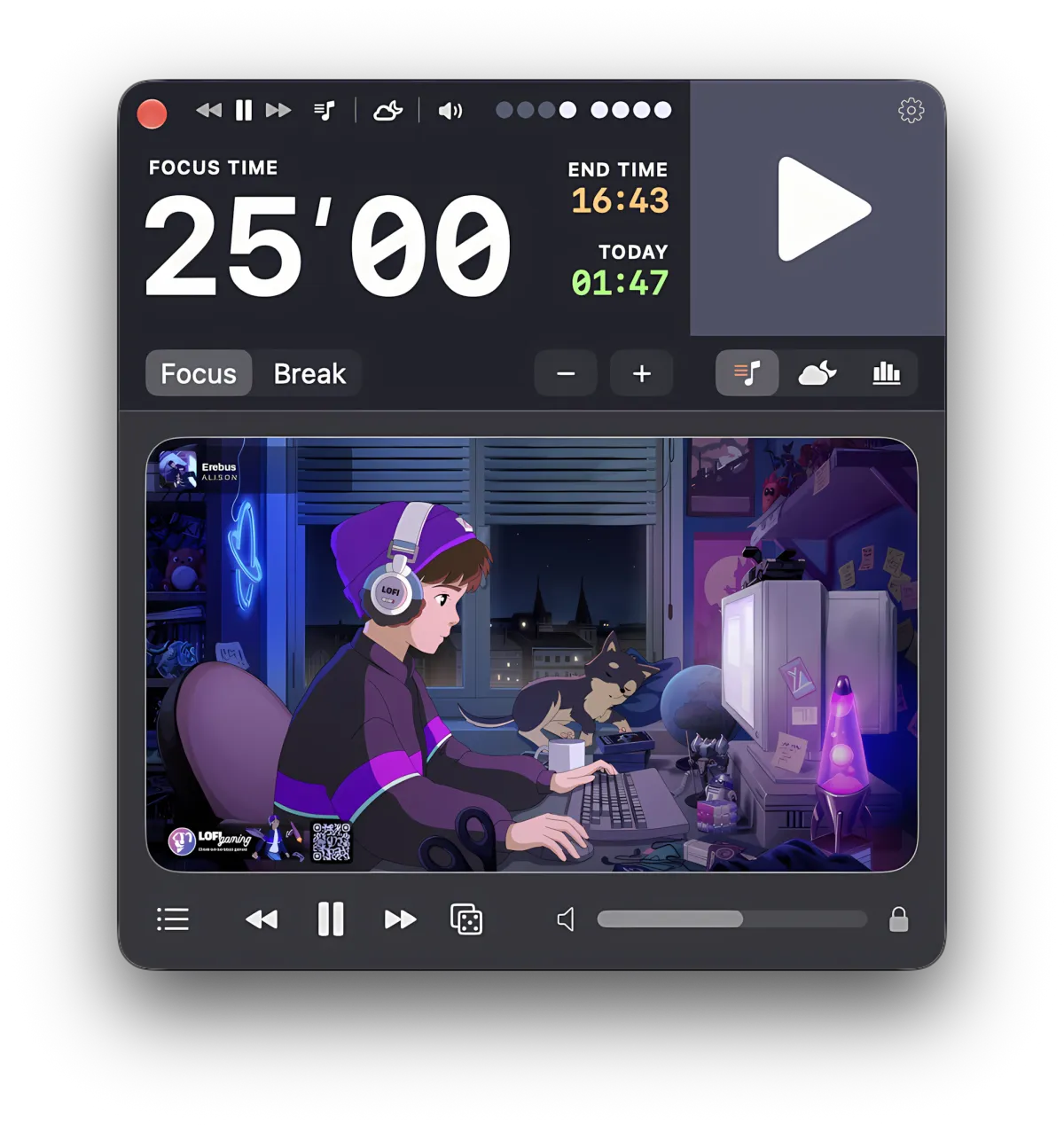
Focusito is a Mac pomodoro timer that takes any focus and break length from 5 to 60 minutes and writes down what you actually did, so a week on 50/10 ends with numbers instead of a feeling. The page below is the numbers themselves: where each one comes from, what the study measured, how to pick, and how to try 50/10 for free first.
50/10 and 25/5 are the same amount of work per hour; the only difference is how often you stop. At 25/5 you stop twice an hour, at 50/10 once. Pick 50/10 when your task takes ten minutes to get into, and 25/5 when starting is the hard part.
The 52/17 rule is one company's measurement from 2014, and the same company measured 112/26 in 2021. The 90-minute block comes from a theory about sleep cycles. Two experiments, from 2023 and 2025, found no difference in how much got done between fixed 25/5-style breaks and breaks you take when you want them.

The interval you pick is a guess until you have a week of real sessions behind it. Focusito takes any focus and break length from 5 to 60 minutes, counts down in the menu bar, and logs every session with its planned and real length, so after a week on 50/10 you can see whether you finished the blocks or stopped at 38 minutes.
It will not set 52/17, 90, or 112 minutes as a plan: lengths move in 5-minute steps and stop at 60. It also has no automatic long break after four sessions; you lengthen the fourth break yourself, and this page shows where.
The four numbers come from four different places
Comparison pages line these intervals up as if they were competing recipes. They are not even the same kind of thing.
25/5 is the number the technique’s author picked in the late 1980s: a 25-minute block, a short break of five to ten minutes, a longer one after four blocks. Wikipedia’s summary has the outline. The 25 was a choice, not a measurement, and the case for it is practical, not physiological: short enough to start when you would rather not, long enough to finish a small piece of work.
50/10 has no origin story. It is 25/5 doubled, which is why it suits people who found 25 minutes ends just as they got going.
52/17 is a measurement, and a narrow one. In 2014, DeskTime, which sells time-tracking software, took the top 10% most productive users of its own tracker, where “productive” means the share of time in apps and websites the tracker classes as productive, and found that group averaged 52 minutes of work and 17 of break. One company, one product’s users, one day. DeskTime’s own write-up, “Does the 52-17 rule really hold up?” by Julia Gifford, dated October 3, 2024, reports what happened when they repeated it: 80/17 in February 2020 and 112/26 in 2021, a jump the company attributes to remote work. No sample size is given. A rule whose work interval doubled in seven years describes a changing sample.
90 minutes is borrowed from sleep research. Nathaniel Kleitman proposed a basic rest-activity cycle of roughly 90 minutes (80 to 120) and suggested it ran through the waking day too; the Wikipedia article on the cycle notes that as early as 1977 other researchers argued there was no evidence for it outside of sleep. A 90-minute block may suit you. The biology does not prescribe it.
25/5 and 50/10 are the same ratio
This is the fact every comparison page skips, and you can check it with a pencil.
Check the arithmetic yourself. Divide work minutes by break minutes, then work out how much of each hour is work:
| Schedule | Work : rest | Share of the hour that is work | Stops per hour |
|---|---|---|---|
| 25/5 | 5 : 1 | 83% | 2 |
| 50/10 | 5 : 1 | 83% | 1 |
| 52/17 (DeskTime, 2014) | about 3 : 1 | 75% | under 1 |
| 112/26 (DeskTime, 2021) | about 4.3 : 1 | 81% | under 1 |
Over eight hours, 25/5 gives sixteen blocks and 50/10 gives eight, and both add up to 400 minutes of work. Switching does not change how much you work. It changes two other things.
How often you are interrupted. At 25/5 a bell rings twice an hour. If your work has a long warm-up, holding a large piece of code in your head or getting back into a chapter, each bell costs you that warm-up again. At 50/10 it costs it half as often.
How much you commit to at once. Starting a 25-minute block is a small promise. A 50-minute block is a bigger one, and on a day when you are avoiding the task, a bigger promise is exactly what you will not make. This is why 25/5 survives: it is the smallest block that still counts as work.
Fewer interruptions against a lower barrier to starting. Which matters more depends on the task, not on a rule.
What the break experiments found
Most pages ranking for this question cite the 52/17 figure and nothing else. There are real experiments, and they say something more useful.
In 2025, Eva Smits, Niklas Wenzel, and Anique de Bruin published “Investigating the Effectiveness of Self-Regulated, Pomodoro, and Flowtime Break-Taking Techniques Among Students” in Behavioral Sciences (volume 15, article 861, DOI 10.3390/bs15070861). Ninety-four psychology students at a Dutch university did a two-hour study session online, randomly assigned to one of three schedules:
- Self-regulated: break whenever you want, for as long as you want.
- Pomodoro: 25 minutes of work, 5 minutes of break, four times.
- Flowtime: work as long as you can focus, then rest in proportion: 5 minutes after up to 25 minutes of work, 8 after 25 to 50, 10 after more than 50.
The authors’ summary, word for word: “Pomodoro breaks led to a faster increase in fatigue, and Pomodoro and Flowtime breaks led to a faster decrease in motivation compared with self-regulated breaks; however, these differences did not result in overall differences in fatigue or motivation levels between conditions. Similarly, no differences were found in productivity levels, task completion, and flow.”
Both halves matter. The fixed 25/5 schedule made fatigue climb faster during the session, and at the end of two hours nobody had done more work, finished more tasks, or reported more flow than anyone else.
An earlier experiment found the opposite on mood. Biwer, Wiradhany, Oude Egbrink, and de Bruin (2023), in the British Journal of Educational Psychology, gave 87 Dutch students 24/6 breaks, 12/3 breaks, or breaks on their own schedule for one study day: the fixed-break groups reported less fatigue and more motivation, and task completion again did not differ.
Neither study tested 50/10. What they agree on is the useful part: a fixed interval did not get more done than letting people decide, and whether the bell helps or wears you down went one way in 2023 and the other in 2025. If you have been treating 25/5 as the proven default and 50/10 as the risky deviation, the evidence does not support that ranking.
Flowtime, the third condition in 2025, is the “work until you cannot, then rest in proportion” method, and it performed the same as the other two. If a fixed timer of any length is what fails for you, that is a different problem, and pomodoro not working for you is where it is taken apart.
Match the interval to the task
With the ratio settled and the study read, the choice comes down to how long your work takes to get into.
Studying. All of the controlled evidence was run on students, and fixed and free-form breaks came out equal on output. For reading and memorizing, 25/5 fits: one block is one section or one deck of cards. For problem sets, where a single problem can take 20 minutes, 50/10 stops the bell landing in the middle of the one you finally understood.
Writing code. The longest warm-up of the three. You load the structure into your head, and a bell at 25 minutes often rings just as it has loaded. 50/10 is a common choice for that reason, and some people go to 60. The thing to resist is running past the bell for an hour because you are almost done; a timer that keeps counting after the bell at least makes the overrun visible.
Writing prose. Drafting rewards 50/10, because stopping mid-paragraph costs the sentence you were about to write. Editing rewards 25/5, because fresh eyes are the point of editing and a break resets them.
Everything you are avoiding. Email, admin, forms: 25/5 or shorter. The block is not there to protect concentration. It is there to make starting small enough that you start.
The long break is a convention, and nobody automates it well
The classic schedule adds a longer rest after every fourth block, typically 20 to 30 minutes, with the short breaks at 5 to 10. The 2025 study did not test it: its pomodoro condition was four blocks of 25/5 in a two-hour session, which ended where the long break would have started. There is no controlled evidence for or against a 20- or 30-minute rest after four blocks. It is a convention that makes sense, not a finding.
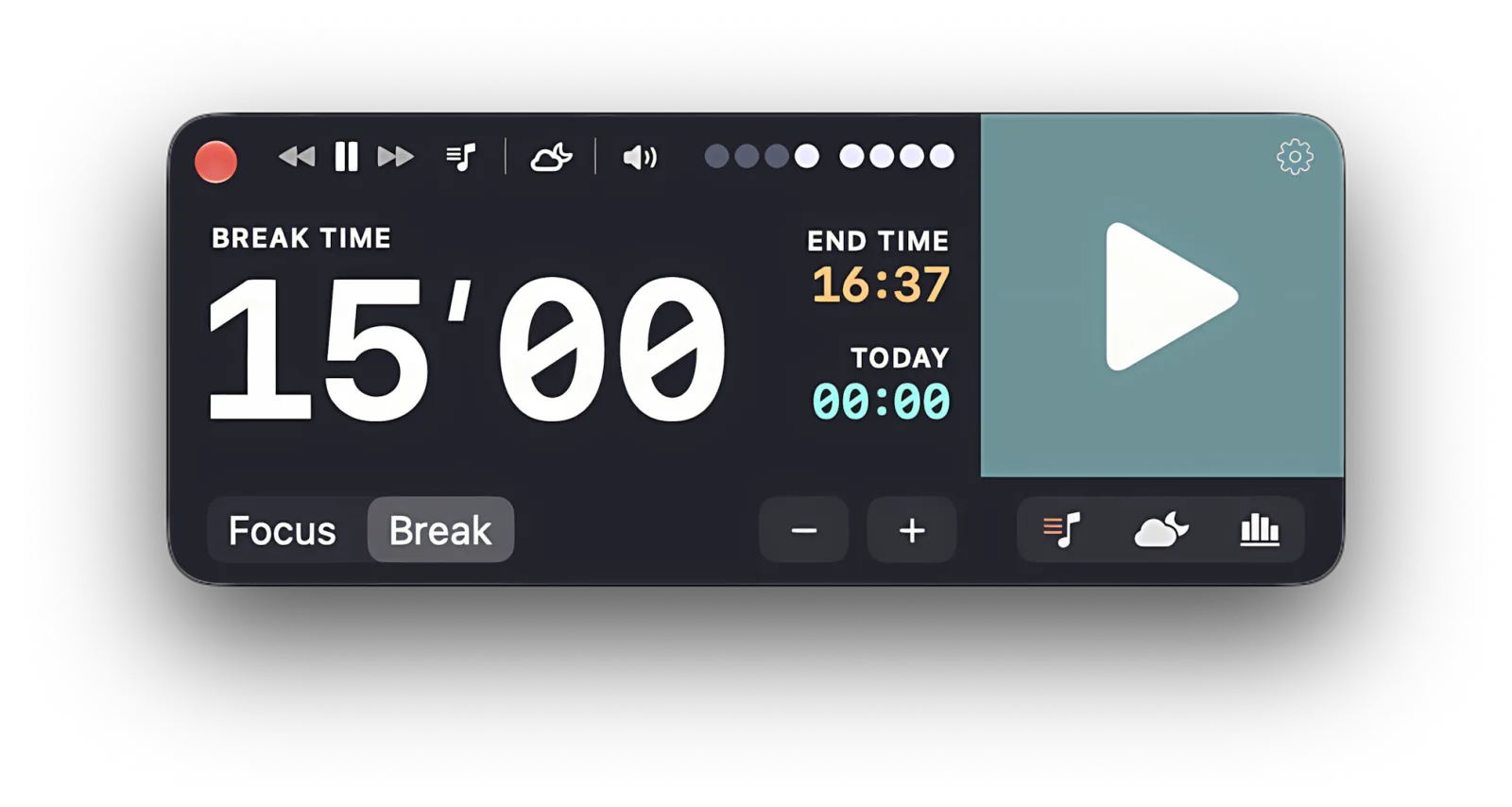
If you run 50/10, four blocks is four hours, so the long break lands at lunch, which is usually fine. If it lands somewhere awkward, move it. The long break is where you leave the desk, and leaving the desk is what makes it work, not the minute count.
Doing it by hand takes one adjustment: before the fourth break, set the break length to 15 to 30 minutes, and set it back afterward. In any timer with a single break length that is the entire mechanism, and it is what Focusito asks of you too: it has no automatic long break, and the last section shows the two ways to lengthen a break there.
Trying 50/10 for free on a Mac
You do not need an app to try an interval for a week.
Try it from the Terminal. One line gives you a 50-minute block, a spoken alert, a 10-minute break, and a second alert:
sleep 3000; say "break"; sleep 600; say "focus"Change 3000 to 1500 for a 25-minute block. Press Control-C to stop it. There is no countdown and no record, and the Mac will say “break” into whatever you are doing. The Clock app that ships with macOS gives you the same thing with a visible countdown: set the work block, then set the break block when it rings.
What neither does is remember anything. If you want to know whether you actually finished the blocks, you are relying on how the week felt, which is the thing this whole question is bad at.
What Focusito does instead
Everything above works without it. Where Focusito earns its place is the part the Terminal line cannot do: it writes the week down.
You set a focus length and a break length: 50 and 10, 25 and 5, 45 and 15, anything in five-minute steps. The countdown runs in the window and in the menu bar. When the bell goes, the window shows itself, and the timer keeps counting past zero until you stop it, so a 50-minute block you ran to 68 minutes is recorded as 68. Every session goes into a log with its planned length and its real length. After a week on 50/10, the Statistics page lists every block with its planned and real length, marks the ones you stopped short, and totals the focus time the week actually held, which is the only thing that settles 50/10 versus 25/5 for you specifically. How many pomodoros fit in a day uses the same log the other way round.
Interval and sound travel together in most people’s search, and in the app. Pick 50/10, turn on a noise or rain, and once you turn on “Start and stop audio with the timer” in the settings, the sound comes up when the focus block starts and goes quiet for the break. The sounds themselves are their own page.
If you do want the mechanical version: focus and break lengths run from 5 to 60 minutes in 5-minute steps, set by right-clicking the big numbers or stepping with plus and minus; the default is 25/5. While the timer runs, “Add 5 Minutes” and “Subtract 5 Minutes” change the current block on the fly, up to the 60-minute ceiling, and subtracting never leaves less than a minute on the clock. On the bell, the defaults are to ring, show the window, and keep counting the overrun with a reminder chime every five minutes until you press Stop; the timer stops itself once it has run for 90 minutes since the block started, pauses not counted. “Stop timer when time runs out” and “Automatically switch between Focus and Break” are both off until you turn them on. “Start and stop audio with the timer” is off on a fresh install; “Mute background audio during breaks” is on by default but only acts once that switch is on, and then it silences both the sounds and the LoFi player. A block you stop early is logged as shortened with its real minutes; one you run to the plan is logged as completed. For a long break after the fourth block, either set the break length to 20 or 30 before it starts and set it back after, or press “Add 5 Minutes” during the break as many times as you need.
What it will not do is what the comparison pages promise: 52/17 is not a settable plan (50/15 and 55/15 are the neighbors), 90 and 112 minutes exceed the 60-minute ceiling, and there is no automatic long break after four sessions.
Common questions
Is pomodoro 50/10 or 25/5 better?
Neither has been shown better: the experiments that exist did not test 50/10. A 2025 randomized study of 94 university students in a two-hour session found no difference in productivity, task completion, or flow between fixed 25/5 breaks, self-timed breaks, and Flowtime, and a 2023 experiment with 24/6 breaks found none in task completion. Both share one ratio, five minutes of work per minute of rest; 50/10 stops you half as often and asks twice the commitment per block.
What is the 52/17 rule, and is it better than 25/5?
The 52/17 rule is not a rule. It is one measurement: in 2014, time-tracking company DeskTime looked at the top 10% most productive users of its own tracker and found they averaged 52 minutes of work and 17 minutes of break. DeskTime repeated the exercise and got 80/17 in February 2020 and 112/26 in 2021. A figure that doubles in seven years is describing its sample, not prescribing anything to you.
How long should a pomodoro long break be?
The common version is a longer rest after every fourth block, typically 20 to 30 minutes, with the short breaks at 5 to 10. The 2025 randomized study did not test the long break at all, so its length is convention rather than evidence. Treat it as the point where you leave the desk: food, a walk, daylight. If the fourth block ends mid-thought, finish the thought and take the long break after.
Why is a pomodoro 25 minutes?
Because that is the length the technique's author settled on in the late 1980s, with a short break of five to ten minutes and a longer one after four blocks. There is no physiological reason behind 25 specifically. It is short enough to start when you do not feel like it and long enough to finish a small unit of work. If 25 is too short to get into your task, 50 keeps the same rhythm with half the interruptions.
Can I set a 50/10 timer in Focusito?
Yes. Focus and break lengths go from 5 to 60 minutes in 5-minute steps, so 25/5, 45/15, 50/10, and 60/10 are one setting each, and you can add or take away five minutes while the timer runs. What you cannot set is 52/17 (the nearest is 50/15 or 55/15), or a 90- or 112-minute block as a planned session. There is no automatic long break either: before the fourth break, lengthen it yourself.