Pomodoro Doesn't Work for Me: The Three Failures Happen at the Bell, Not in You
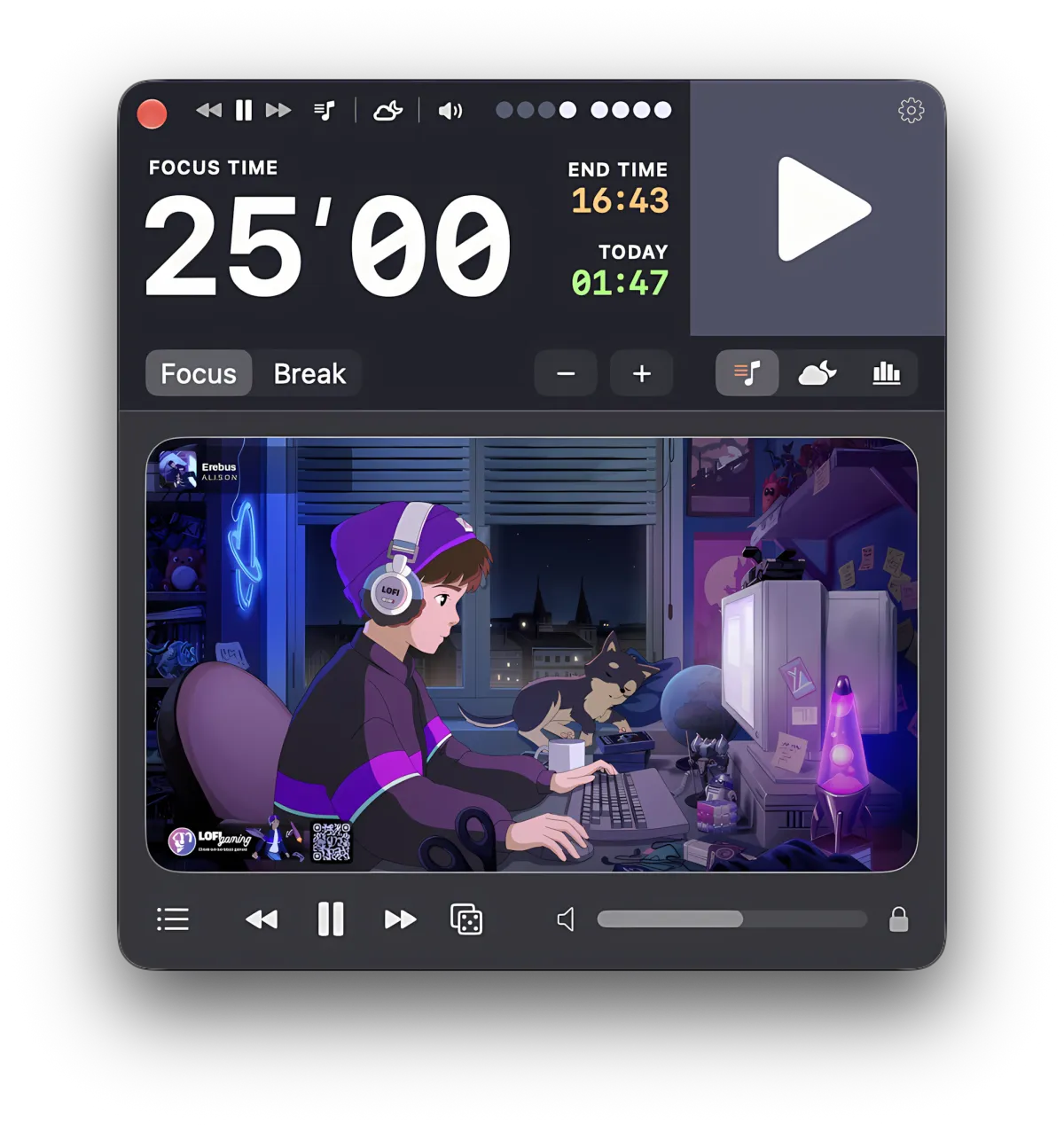
You typed “pomodoro doesn’t work for me”, maybe with ADHD after it. The method gets recommended everywhere, and every time you try it the same thing happens: the bell goes off at the one moment you were finally working, or the five-minute break turns into an hour, or you never get as far as pressing Start.
The usual advice is to try harder, or to try a different length. The three failures are not about trying. They are about what a timer does at the boundary: what happens at the bell, what marks the switch into a break and back, and what counts as a session at all.
Focusito is a Mac timer built around those three boundaries: the countdown keeps going past the bell instead of stopping, the sound you work against marks the break, and a short or interrupted session is still written down. The page below is the three failures, the free way to fix each, and where a timer earns its place.
The three ways pomodoro fails all happen at the bell, and none of them is a willpower problem. The bell lands mid-thought and a strict timer stops the clock. The break has no edge and swallows the afternoon. The first session is 25 minutes long and never starts.
Each one has a plain fix. Let the bell be a signal, not a stop. Let something you hear mark the switch into the break and back out of it. Make the first session short enough to start, and count it even if you stop early.
None of that needs a special mode. The length matters less than what the timer does when the length runs out.

If what keeps breaking is the bell, change what the bell does. In Focusito the countdown rings and then keeps counting, up to ninety minutes from the start, with a reminder every five minutes until you stop it. Let the timer start and stop your audio and the sound you work against falls silent for the break and comes back with the next focus, so the switch is heard rather than watched. A ten-minute session is an ordinary choice, and stopping early still lands in the log.
It does not help you start, and it keeps no task list; the session you cannot begin is yours to begin. There is no ADHD mode. A modified pomodoro here is a length you pick, not a switch you flip.
The three failures everyone reports
Read enough threads and the complaints converge on three. You got into a groove around minute 22 and the timer cut it. You took the five-minute break, opened one video, and surfaced ninety minutes later. Or 25 minutes of unbroken focus was exactly what you could not face, and nothing started.
Notice where each one lives: the end of the focus, the end of the break, the start of the first session. All three are the boundary, and the boundary is the timer’s job.
Check it for yourself with one multiplication. A 25/5 split in an eight-hour day is sixteen cycles, which is thirty-two bells. Sixteen of them land on your focus. If the technique feels like being interrupted for a living, that is because, arithmetically, it is. Which length suits you is its own question with its own page; this page is about what happens when the bell rings, whatever the length.
Failure one: the bell lands mid-thought
The strict version treats the bell as a stop. The clock halts, the screen demands a decision, and the decision is between losing the thread and ignoring the method.
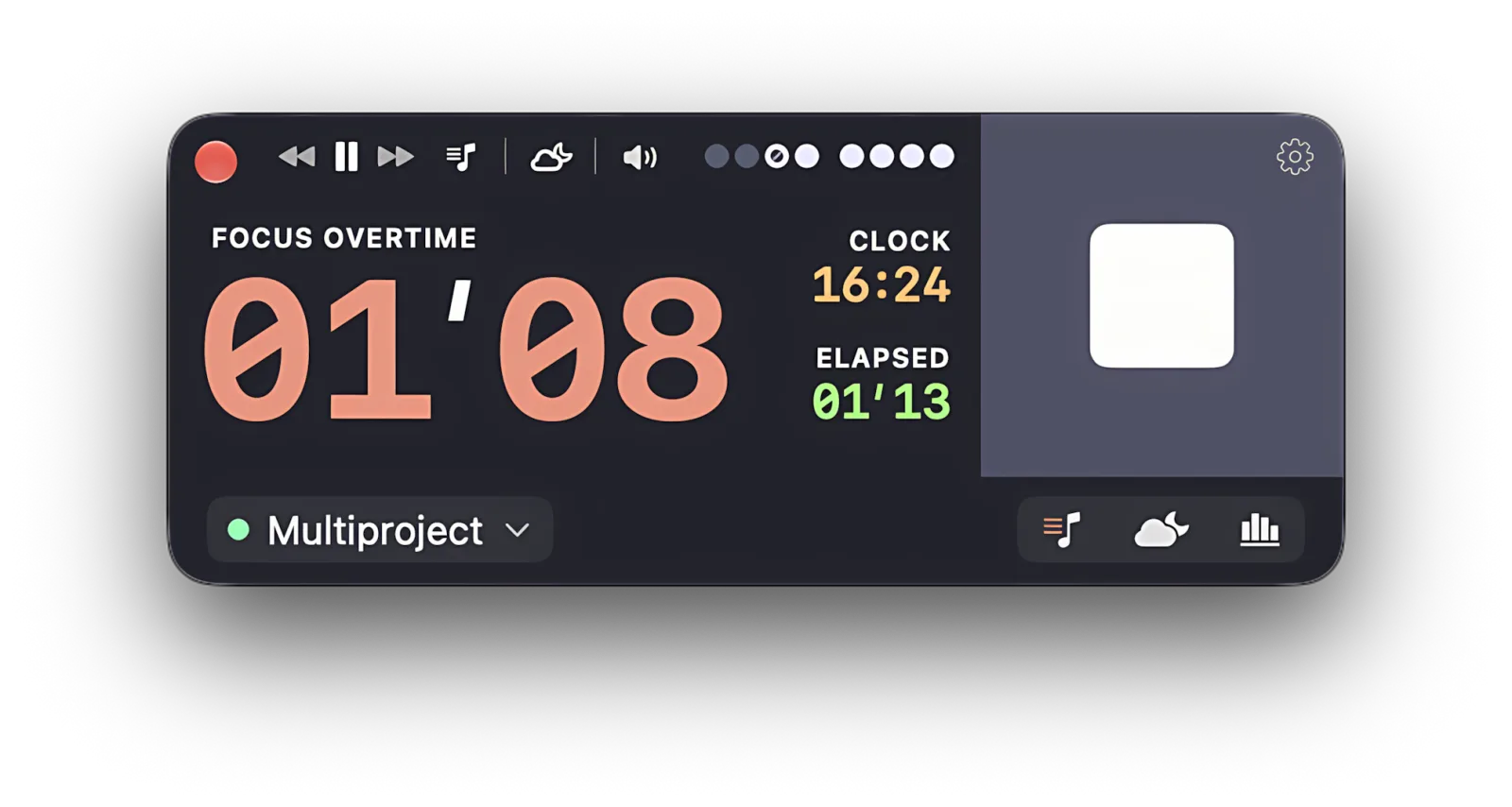
The fix is not a longer interval. That moves the bell; it does not stop it landing on a good stretch, because you cannot know in advance when the good stretch will come. The fix is a bell that does not stop anything: a signal that time is up, after which the clock keeps counting, so you stop when the thought is finished.
The free version is one line in Terminal. Run it, go and work, and nothing on your Mac changes when the time is up except that it says so:
sleep 1500; say "twenty-five minutes"Try it with sleep 5 first to hear it. That is the whole mechanism: a signal, no stop. What it lacks is a record of how long you went on, and a second nudge if you missed the first.
What Focusito does at the bell: it plays its end-of-timer sound, brings its window forward without taking the keyboard from you, and the digits count back up from zero under the label FOCUS OVERTIME. There is no macOS notification to dismiss. Every five minutes the sound plays again and the window comes forward again, until you press Stop. If you never do, the timer stops on its own once it has run for ninety minutes since you pressed Start, pauses not counted: a 25-minute session can run to 90, a 60-minute one gets 30 minutes of overtime. The other option is to add five minutes while the countdown is still running, up to a 60-minute session, which moves the bell instead of running past it. Either way the log keeps the planned length and the real one side by side.
Failure two: the break with no edge
The break fails for the mirror-image reason. The focus had a hard edge and the break has none. Five minutes is a number you had to remember, and a browser tab does not remind you.
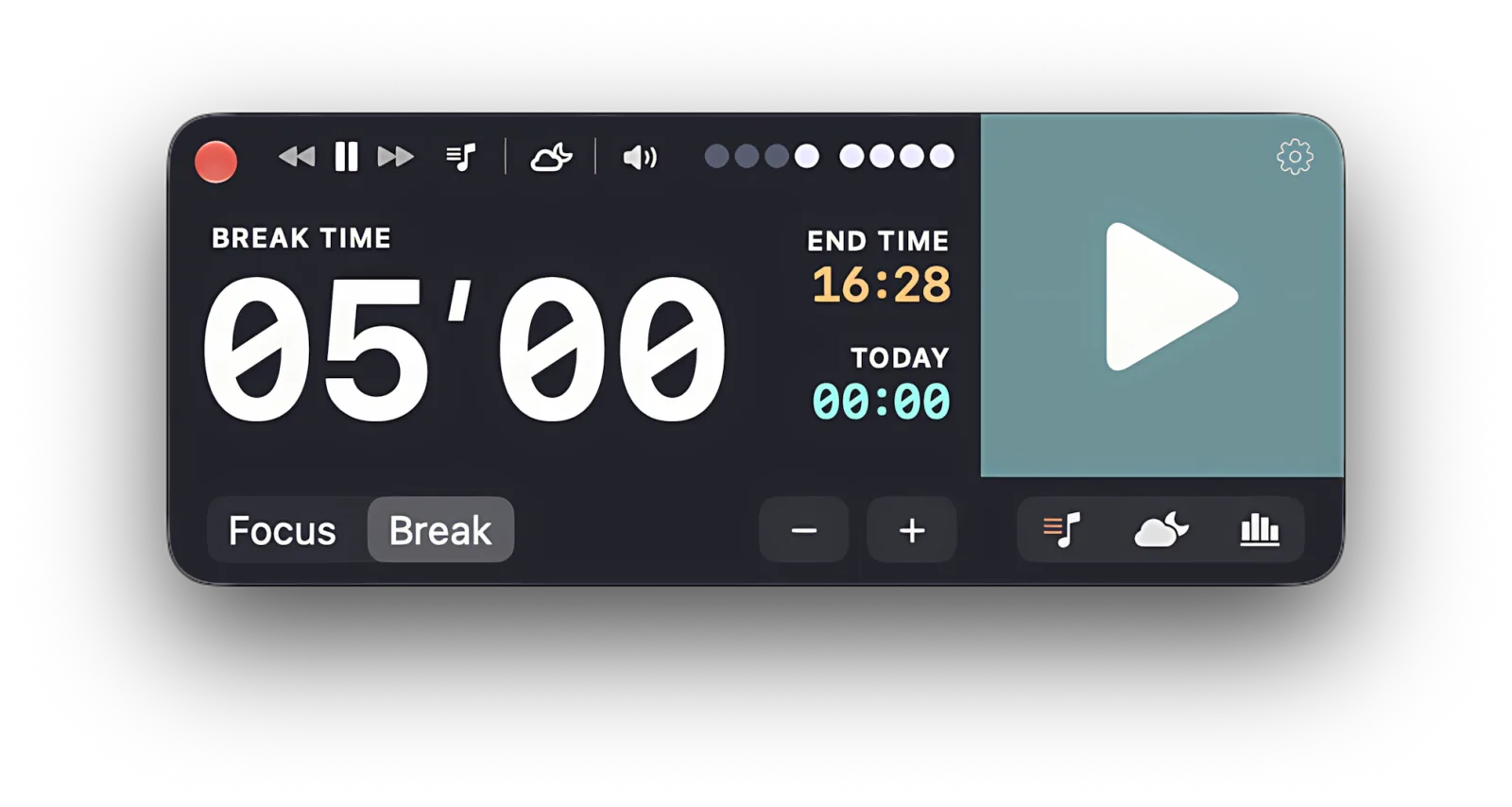
A notification is a weak edge: a thing to see, and you were not looking. The strong edge is a change in what you hear. The sound you were working against goes quiet when the break begins and comes back when the next focus starts, so the switch is audible and you do not have to watch for it.
The free version is the same Terminal line with a smaller number. sleep 300; say "back" gives the break an end. It will not give it a beginning, and it will not change what is playing. The sounds themselves, white, pink, and brown noise included, are a separate page; here only their timing matters.
What Focusito does at the break: once you turn on the setting called Start and stop audio with the timer, the background sounds play while the focus runs and fade out in its last ten seconds, the LoFi player, if you have started it, pauses at the bell, and both stay muted for the break. Both layers, not one. They come back on their own with the next focus. The end-of-timer sound stands apart from all this: it ignores the mute button in the header, deliberately, since that is the one sound you are meant to hear.
The break is also allowed not to happen. There is nothing to press to skip it; after you stop the focus, the timer stays on focus, and a break happens only if you switch to it and press Start. If you would rather have that switch made for you, a second setting flips the timer between focus and break each time you stop a session that ran at least a minute; you still press Start yourself. Both settings are off on a fresh install.
What to do with the five minutes is a shorter question than the internet makes it: something with an edge, something quieter than the work, something you can leave. When the room goes silent, you know which side of the boundary you are on.
If the break keeps turning into a video, that is a blocker’s job rather than a timer’s, and what Forest actually offers on a Mac is the honest list of what exists for it.
Failure three: the session that never starts
The third failure is the one timers are worst at, because it happens before the timer is running. A 25-minute block is a commitment, and on the days that matter it is one you cannot make.
Two things change this, and neither is motivational. The first session can be short: ten minutes is a legitimate focus, and so is five. And stopping early has to count, because a timer that records only perfect sessions teaches you that an imperfect one is worthless, and you stop starting them.
Check your own timer on this. Start a session, stop it after two minutes, and look for it afterwards. Many timers show nothing. The two minutes happened, and the record says they did not.
What Focusito does with a short session: the focus length is anything from 5 to 60 minutes in steps of five, picked from the timer’s context menu or stepped up and down. A session that runs for at least one full minute goes into the log whatever you planned: stopped before the plan, it is marked shortened; at or past the plan, completed. Under a minute, or restarted from zero, it is cancelled. The ledger shows planned against real, and the statistics page covers what the log does with a week of them.
What it cannot do is press Start for you. There is no task list to pick from, no nudge to begin, no streak to protect. The honest version of a short first session is that you still have to make it.
Flowtime, flowmodoro, and what the 2025 trial found
Flowtime is the method people reach for after pomodoro fails them: no fixed interval. You work until you naturally stop, note how long that was, and take a break sized to it. Flowmodoro is the same idea with a timer running in the background to do the noting.
A randomized trial that compared them was published in 2025: 94 university students in a two-hour study session, split between fixed 25/5 breaks, flowtime breaks, and breaks they chose themselves. Productivity, task completion, and flow did not differ between the groups; the 25/5 group’s fatigue rose faster than the self-chosen group’s. The full numbers, and what they mean for choosing a length, are on the interval page. Read for this page, the result is reassuring: dropping the strict bell cost nobody productivity, and bought nobody any. The reason to change what the bell does is not output; it is frustration, and whether you start at all.
Focusito is not a flowtime timer, and this is the honest line. It gives you the half that matters at the end of a focus: the countdown runs past the bell, so a good stretch is not cut short. It does not give you the other half. The break is a length you set, from 5 to 60 minutes, not a fraction of what you worked, and nothing in the app computes one for you.
What Focusito does instead
Most of what this page describes is a timer refusing to be strict in three places, and you can get a surprising amount of it from two Terminal lines and a note of how long you went. If that is enough, stop here.
Focusito is the version where the three boundaries are handled for you. The bell rings and the clock keeps counting, and keeps reminding you, until you stop it or ninety minutes have passed since Start. The sound you work against goes quiet for the break and comes back for the focus. The ten-minute session you managed to start is in the log that evening, and so is the one you stopped after four.
If you do want the mechanical version: the end-of-timer sound is one of five, or none, and it plays regardless of the header mute. The reminder repeats every five minutes in overtime; the cap is ninety minutes of running time from the start of the session. The audio automation (start with the focus, fade the sounds out ten seconds before the bell, mute both layers during the break) hangs on one setting, Start and stop audio with the timer, with the break mute as a toggle under it, on by default but inert until the first is on. Automatic focus-break switching is a third setting, off by default, and a fourth stops the timer at the bell for anyone who prefers the strict version. A session counts from one full minute: shortened before the plan, completed at it, cancelled below the minute or on a restart. After the trial, three of the sounds, white noise among them, and one LoFi station stay free; brown noise does not.
None of that starts the session for you, and there is no ADHD mode behind any of it. The modified pomodoro is a length you pick from the menu, and the rest is a timer that behaves at the bell.
Common questions
Does pomodoro work for ADHD?
This page cannot answer that, and neither can a timer. The three complaints that recur, from people with ADHD and without, are the bell interrupting a good stretch, the break that swallows the afternoon, and the first session that never starts. All three are timer behaviour at the boundary, and all three change without a mode: a bell that does not stop the clock, a sound that marks the switch, a short session that still counts.
Is it only me, or does the strict version get in the way?
No. An Ask HN thread from 12 February 2024, "Alternatives to the Pomodoro technique?", drew 126 points and 122 comments. One commenter swapped hard stops for "a sound notification" at the end of each focus and break, which "creates a lot less frustration as I can finish the task I am working on without losing track of the time passing." Another: "the technique was only good for 'starting' the work. After that, the technique only got in the way."
What is the best pomodoro length for ADHD?
There is no evidenced best length. A 2025 randomized trial of 94 students found no difference in productivity, task completion, or flow between fixed 25/5 breaks, flowtime breaks, and self-chosen breaks. The useful question is which length you can actually start. Ten minutes is a legitimate first session; so is five. Focusito takes any length from 5 to 60 minutes in steps of five, and a session stopped early still enters the log once it has run a full minute.
What is flowtime, or flowmodoro, and is it better?
Flowtime drops the fixed interval: you work until you naturally stop, note how long that was, and take a break sized to it. In the 2025 trial it was one of three conditions and did not beat the others on productivity or flow. Its appeal is the missing bell. Focusito gives you half of it, a countdown that keeps running past the bell, up to ninety minutes from the start. It does not size the break; you set that yourself.
What should I do during a pomodoro break?
Something with an edge, quieter than the work. The break that goes wrong is the one with no end in sight: one video becomes an afternoon. If the sound you work against stops when the break begins and returns with the next focus, the switch is something you hear, not something to watch for. In Focusito that is the break mute, which silences both the background sounds and the LoFi player once the timer is allowed to run your audio.
Does Focusito have an ADHD mode?
No, and it would be dishonest to call anything in it that. What it has are ordinary settings that answer the three failures: the countdown runs past the bell instead of stopping, a reminder sounds every five minutes until you stop it, the sound you work against marks the break if the timer manages it, and a five- or ten-minute session is a normal choice that still gets logged. A modified pomodoro is a length you pick, not a mode.